01 - Service Drop
Home Buyer's Guide to Electrical Service
When you're shopping for a home, the electrical service is one of the most critical—yet often overlooked—components that determines both your safety and your home's functionality. As a professional home inspector, I've seen countless situations where understanding the electrical service could have saved buyers from expensive upgrades, safety hazards, or even prevented tragic electrical fires. Let me share the essential knowledge you need to make an informed decision.
Understanding Your Home's Electrical Service System
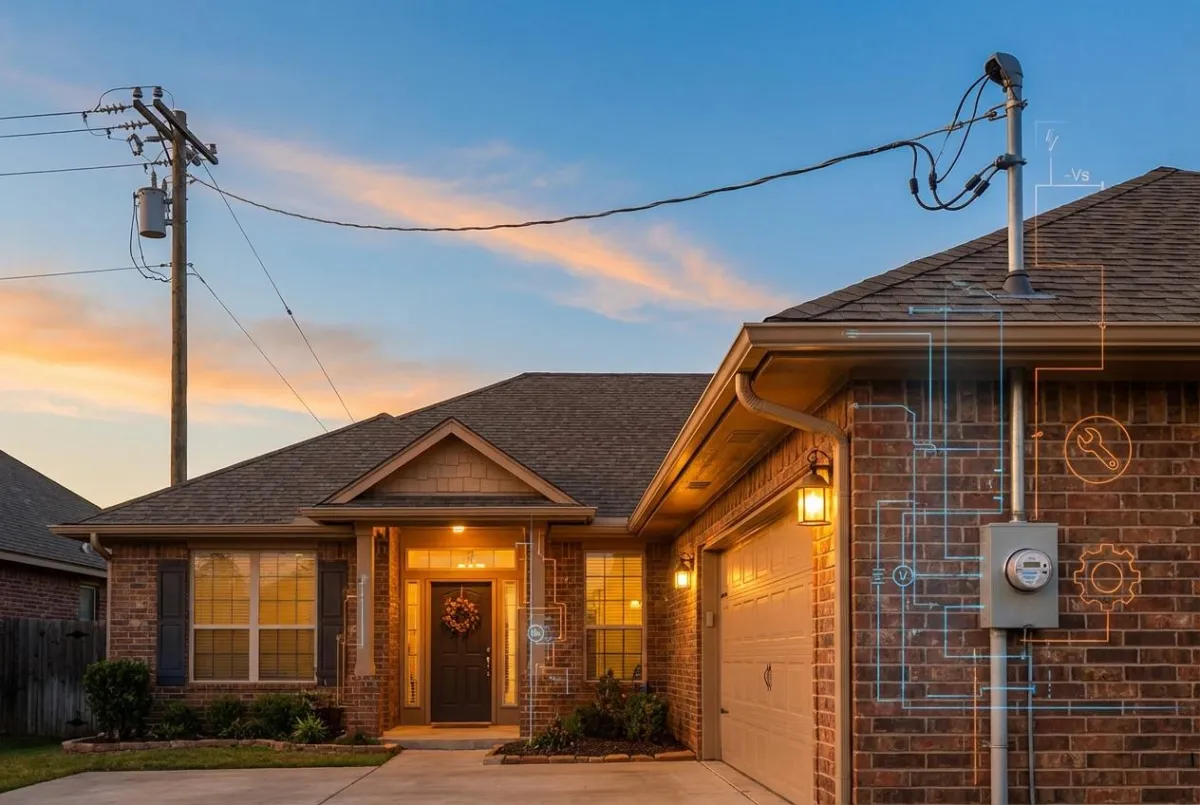
Think of your home's electrical service as the gateway through which all electricity enters your house. This system includes several key components: the service drop (overhead wires) or service lateral (underground wires), the service mast, the electric meter, service entrance conductors, service equipment (main disconnect), and the panelboard. Not every home has all these components, and their configuration varies based on the home's age, location, and whether the service is overhead or underground.
Overhead vs. Underground: What's Better for You?
Overhead Service Drops are common in older homes and rural areas. You'll see wires running from the utility pole's transformer to a connection point at the house—this is called the service point. Here's what's crucial: this point typically marks where the utility company's responsibility ends and yours begins. The wires may attach directly to your home's fascia or wall, or they may connect to a service mast—that pipe extending above the roofline with a curved "gooseneck" service head at the top.
Underground Service Laterals are increasingly common in newer construction and represent the more desirable option. Why? Simple: underground conductors are far less likely to suffer damage from weather, falling tree limbs, or deterioration from sun exposure. These conductors run from the transformer through underground conduit, emerge through a riser at your house, and connect to the meter base.
When evaluating a home, an underground service lateral is a positive feature that suggests both newer infrastructure and reduced maintenance concerns.
Critical Safety Feature: Water Management
Here's something many buyers never consider: water is electricity's enemy, and poor water management in electrical service is a serious fire hazard. Water can travel down conductors and infiltrate your meter base or panelboard, damaging components and increasing electrical resistance at connections. Increased resistance generates heat, and heat creates fire risk.

What to look for: The service entrance conductors should form visible "drip loops" below the service head—these U-shaped dips allow water to drain off before entering the system. The service head itself should angle downward to prevent water intrusion. If you're looking at a home where the service head points upward or the drip loops are inadequate or absent, this is a red flag requiring correction.
Clearance Requirements: Safety Distances Matter
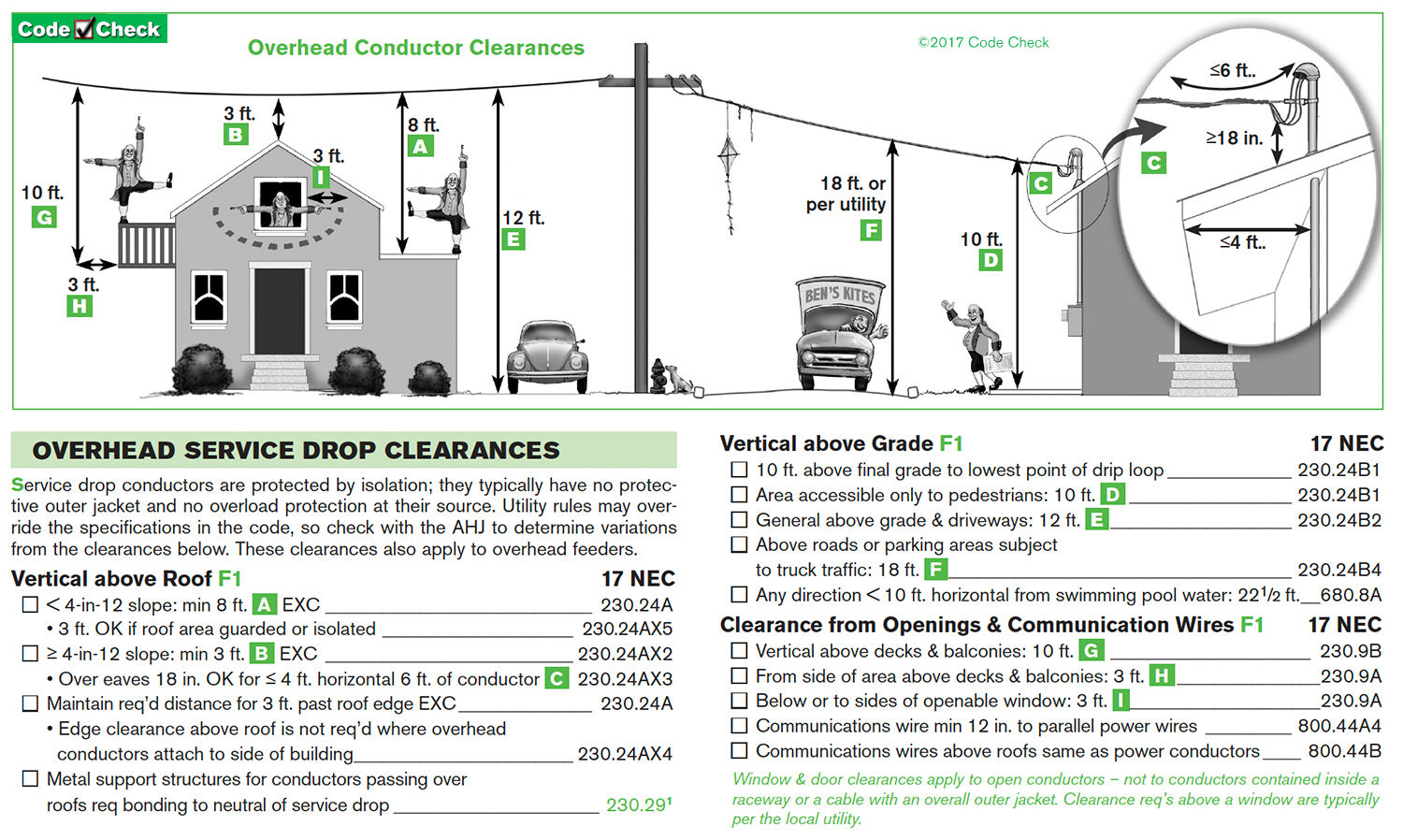
Electrical codes establish minimum clearance distances for good reason—these prevent accidental contact and damage. When viewing a property, be aware of these critical measurements:
Ground Clearances:
At least 10 feet above pedestrian walkways or ground level
Minimum 12 feet above residential driveways (where your car passes)
At least 18 feet above public streets or areas with truck traffic
A substantial 22½ feet above swimming pools, extending 10 feet in all directions
Roof Clearances:The standards vary based on roof slope. For flatter roofs (less than 4/12 slope), service drop conductors must maintain 8 feet of clearance. For steeper roofs (4/12 slope or greater), this reduces to 3 feet. The most common situation you'll encounter is an 18-inch clearance, which applies when less than 6 feet of conductor extends above the roof and crosses no more than 4 feet of roof surface.
Building Opening Clearances:Service drop conductors must maintain at least 3 feet of horizontal distance from operable windows, doors, decks, balconies, and similar features. This prevents someone from accidentally contacting energized conductors when opening a window or stepping onto a deck.
Pay special attention if the home has had additions, new rooms, or porch roofs added. These modifications frequently create clearance violations that went unaddressed. A service drop that was once safely positioned may now hang dangerously low over a new deck or too close to an added second-story window.
Electrical Service Capacity: Is It Adequate for Modern Living?
This is where many buyers discover they're facing a significant—and expensive—upgrade need.
Voltage Requirements
Almost all modern homes receive 240-volt single-phase service from the utility. This is what you want and need. If you encounter a home with only 120-volt service, consider this a serious deficiency requiring immediate attention. Most major appliances—electric ranges, ovens, water heaters, clothes dryers, air conditioners—require 240 volts to operate. A 120-volt service severely limits your home's functionality and likely cannot safely supply adequate electrical current.
You may occasionally hear older electrical service referred to as "220 volts." This terminology is outdated—modern utilities don't supply this voltage, though the term persists colloquially.
Current Capacity: The 100-Amp Minimum
Here's a critical number:100 amperes is the absolute minimum service current for a modern single-family home. Anything less represents a reportable deficiency that will likely require costly upgrading, regardless of whether it was adequate when originally installed.
But here's the reality: even 100 amps is often marginal unless you have a small home with gas service for heating, water heating, and clothes drying. Most newer homes feature 150 or 200-amp service, while large homes may have 300 to 400-amp service to accommodate multiple HVAC systems, electric vehicle chargers, hot tubs, and modern appliances.
For townhouses or two-family homes, each unit may have as little as 60-amp service, though this severely limits electrical capacity and may necessitate future upgrades.
How Service Amperage is Determined
Understanding how professionals determine service amperage helps you evaluate a home's electrical capacity. The service amperage is determined by the lowest-rated component in the chain, starting from the service entrance wires and concluding at the service equipment and panelboard.
For example: If the service entrance wires are sized for 200 amps, but the main breaker and panelboard are rated for only 150 amps, your actual service capacity is 150 amps. The limiting component determines your capacity.
A dangerous situation to watch for:Sometimes homeowners upgrade the panelboard and service equipment to higher amperage ratings without upgrading the service entrance wires. This creates a serious fire hazard because the higher-rated equipment can allow more current through the wires than they can safely handle, potentially melting insulation and starting electrical fires. This is why professional evaluation is essential—what looks like a robust 200-amp panel might actually be limited by 100-amp wiring hidden in the walls or overhead.
Service Equipment: Your Main Disconnect
The service equipment—commonly called the main breaker or main disconnect—is your emergency shut-off for all electricity entering the home. This critical component may take several forms: circuit breakers (most common in newer homes), fuses, or switches containing fuses.
What you should see:Service equipment is typically located in one enclosure, though it may be divided into multiple enclosures in one location. If multiple enclosures exist, you should be able to disconnect all power to the home by operating no more than six switches, breakers, or fuse blocks in any combination.
The service equipment should be clearly labeled indicating its function and should be listed specifically for use as service equipment. While older fuse blocks are no longer permitted for new installations, existing fuse-based service equipment may remain if it's safe and functional.
Special note for manufactured homes:If you're considering a manufactured (mobile) home, the service equipment is typically located on a post in the yard near the home rather than attached to the structure itself. The panelboard inside should be properly configured as a subpanel.
Understanding Service Load Calculations
When evaluating whether a home's electrical service is adequate for your needs, qualified electricians use load calculations that account for the reality that not all circuits operate simultaneously. These calculations consider:
General lighting and receptacle circuits throughout the home
Kitchen and laundry circuits, which draw substantial power
Major appliances like electric water heaters, ranges, and dryers
HVAC equipment, including air conditioning, heat pumps, or electric heating
The calculation applies reduction factors since you won't simultaneously operate every circuit at maximum capacity. However, if you're planning to add significant electrical loads—electric vehicle charging, a hot tub, additional air conditioning, a home addition, or converting from gas to electric appliances—the existing service may prove inadequate.
While detailed load calculations are beyond the scope of home inspection, understanding this concept helps you ask the right questions: "Will this service support the lifestyle and appliances I'm planning?"
Critical Defects Every Home Buyer Should Recognize
When touring properties, watch for these serious electrical service deficiencies that I commonly encounter:
Immediate Safety Concerns:
Service drop conductors running through tree limbs or branches—this causes abrasion, insulation damage, and creates serious hazards during storms or tree maintenance
Damaged or missing insulation on service drop or service entrance conductors
Exposed, uninsulated connections where the service drop connects to service entrance conductors
Inadequate or absent drip loops, allowing water infiltration
Missing, loose, bent, or damaged service masts or service heads
Water Intrusion Risks:
Deteriorated or improperly installed flashing where the service mast penetrates the roof
Meter bases and electrical enclosures not properly sealed where they attach to siding or wall coverings—these unsealed gaps are prime water infiltration points
Damaged or deteriorated meter bases and electrical enclosures showing rust, corrosion, or physical damage
Clearance Violations:
Inadequate clearances between service conductors and roofs—particularly common when room additions or porch roofs have been added
Service drops too close to the ground, driveways, or building openings like windows and doors
Conductors positioned where they could be contacted from decks, balconies, or ladders
Installation Issues:
Loose or damaged conduit connections at enclosures
Loose service drop connections at the house attachment point
Service entrance conductors improperly secured or supported
The Most Dangerous Condition:A mismatched upgrade where the panelboard and service equipment have been replaced with higher-amperage components, but the original, lower-capacity service entrance conductors remain. This allows excessive current through undersized wires—a significant fire hazard that requires immediate correction.
Making an Informed Decision
Understanding your potential new home's electrical service empowers you to make informed decisions. Here's my professional advice:
Before making an offer, ensure your home inspection specifically addresses these electrical service components in detail. If the inspector identifies deficiencies, obtain estimates for corrections—electrical service upgrades can range from a few hundred dollars for minor repairs to $3,000-$8,000 or more for complete service replacements.
Consider your future needs.That charming older home with 100-amp service might be adequate today, but will it support your plans for central air conditioning, electric vehicle charging, or a kitchen remodel with modern appliances? Planning for known future needs now is far more cost-effective than upgrading later.
Underground service is preferable to overhead when choosing between otherwise comparable homes. The reduced exposure to weather and physical damage translates to lower long-term maintenance and fewer service interruptions.
Service capacity is not just about what's adequate—it's about value. A home with robust 200-amp service is more marketable and future-proof than one with barely adequate 100-amp service, even if both meet minimum requirements today.
Your Peace of Mind Investment
The electrical service is your home's lifeline to modern living. Every light, appliance, heating and cooling system, and electronic device depends on this infrastructure functioning safely and reliably. Unlike cosmetic issues that are immediately visible, electrical deficiencies often hide behind walls or overhead, making professional evaluation essential.
When you understand what to look for and which questions to ask, you transform from a passive home shopper into an informed buyer who can accurately assess both the safety and future adequacy of this critical system. This knowledge protects your investment, ensures your family's safety, and prevents expensive surprises after closing.
The electrical service may not have the emotional appeal of granite countertops or hardwood floors, but it's infinitely more important to your daily life and long-term satisfaction with your home. Make it a priority in your home-buying decision—your future self will thank you.


